
Free Online Course from Edx: Fundamentals of Macroeconomics
This course includes a macroeconomic analysis and overview of aggregate production, inflation, unemployment, and economic policies
- English
- With Certificate

Tutor Name
edXInterested learners
About the Course
edX platform is offering a free online course entitled "Fundamentals of Macroeconomics". In this course, you will discover everything that economists know about markets, their failures, and how this view can help you understand the most relevant economic problems. You will also be able to find answers to the following questions:
- Why some societies manage to coordinate and prosper in the long run and others don’t.
- Are developing countries doomed? What is postponing their prosperity?
- Why even the most successful economies experience occasional crises that compromise the quality of life?
- Why are there spikes in the unemployment or inflation that cause pain in our societies? What can we do about it?
Duration:
The course lasts 6 weeks, 2-3 hours per week.
Prerequisites:
- Secondary school algebra.
- Basic mathematics concepts.
- Ability to read basic graphs.
Syllabus:
Week 1: Introduction and Gross Domestic Product
- Macroeconomic aggregates and Gross Domestic Product.
- The value-added and the return of productive factors.
- The components of GDP.
- Real and nominal GDP and the GDP deflator.
- The determinants of productivity in the long run.
Week 2: Savings and Investment. Labor Market. Consumer Price Index
- Savings and investment in a closed economy.
- The market for loanable funds.
- Main statistics of the labor market.
- Types of unemployment: the natural rate and cyclical unemployment.
- The consumer price index and the measurement of inflation.
Week 3: Money, monetary system and inflation
- Definitions of money.
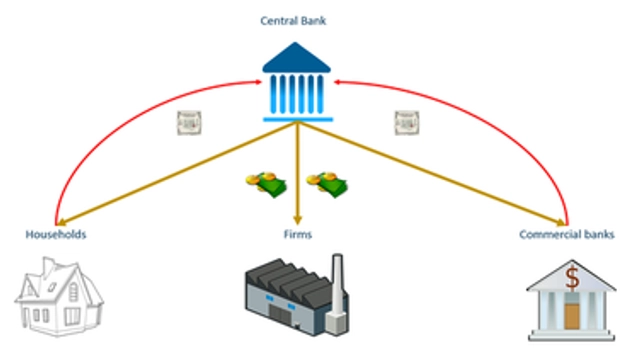
- The fractional-reserve banking system.
- The central banks.
- The tools for monetary control.
- Money demand, money supply, and price level determination.
- The quantity theory of money and the causes of inflation over the long run.
Week 4: Open economies and exchange rates
- Open economies and trade balances.
- Capital flows.
- The relationship between savings, investment, and capital flow in open economies.
- Nominal and real exchange rate.
- The Purchasing-power Parity theory for determination of nominal exchange rates.
- The relationship between inflation and depreciation.
Week 5: Economic fluctuations
- Empirical regularities of economic fluctuations.
- The aggregate demand curves.
- The long-run aggregate supply curve.
- The short-run aggregate supply curve.
- The long-run equilibrium and the short-run economic fluctuations.
Week 6: Fiscal and Monetary Policies
- The money demand and the theory of liquidity preference.
- The impact of monetary policies on aggregate demand.
- Fiscal policies and the multiplier effect.
- Fiscal policies and the crowding-out effect.
- The argument for and against the use of fiscal and monetary policy to stabilize the economy.
Learning Outcome:
Students will learn the following:
- The GDP, its meaning, measurement, and components.
- The main indicators of the labor market and the nature of unemployment.
- Savings, investment, and the financial system.
- The monetary and the banking system.
- Central banks, monetary policies, and inflation.
- International trade, capital flows, and exchange rates.
- Economic fluctuations.
- Fiscal and monetary policies.
Course Fees:
There are no fees for enrolling or studying the course, but there is a choice for the student to seek a verified certificate of completion of the course for $50, which is characterized by:
- Receive an instructor-signed certificate with the institution's logo to verify your achievement and increase your job prospects.
- Add the certificate to your CV or resume, or post it directly on LinkedIn.
- Give yourself an additional incentive to complete the course.
- EdX, a non-profit, relies on verified certificates to help fund free education for everyone globally.
About EdX:
EdX is an online learning destination and a massive open online course provider, it is founded by Harvard University and Massachusetts Institute of Technology (MIT) in 2026. edX offers high-quality courses from the world’s best universities and institutions to learners everywhere. It is open to students from around the world, who are interested in different fields like computer science, languages, engineering, psychology, writing, electronics, biology or marketing. With more than 130 global partners, edX counts the world’s leading universities, nonprofits, and institutions as their partners to provide the best online courses on the Web.
See more available Ph.D. scholarships on For9a
See more available grants on For9a
See more opportunities in Canada available on For9a
Taught by
Founded in 2012 by Harvard University and MIT, edX is a premier online learning platform and MOOC provider offering high-quality courses, professional certificates, and degrees from top-tier universities and institutions worldwide, with a mission to increase access to education. The platform enables over 86 million learners to acquire in-demand skills in fields like computer science, AI, and business, allowing them to audit courses for free or pay for verified certificates to boost their professional careers.
Read more.