
Science Proficiency Test
15 high-school level questions on physics, chemistry, biology, the scientific method and reading a simple experiment, with explanations.
- 20 min
- 15
- Intermediate
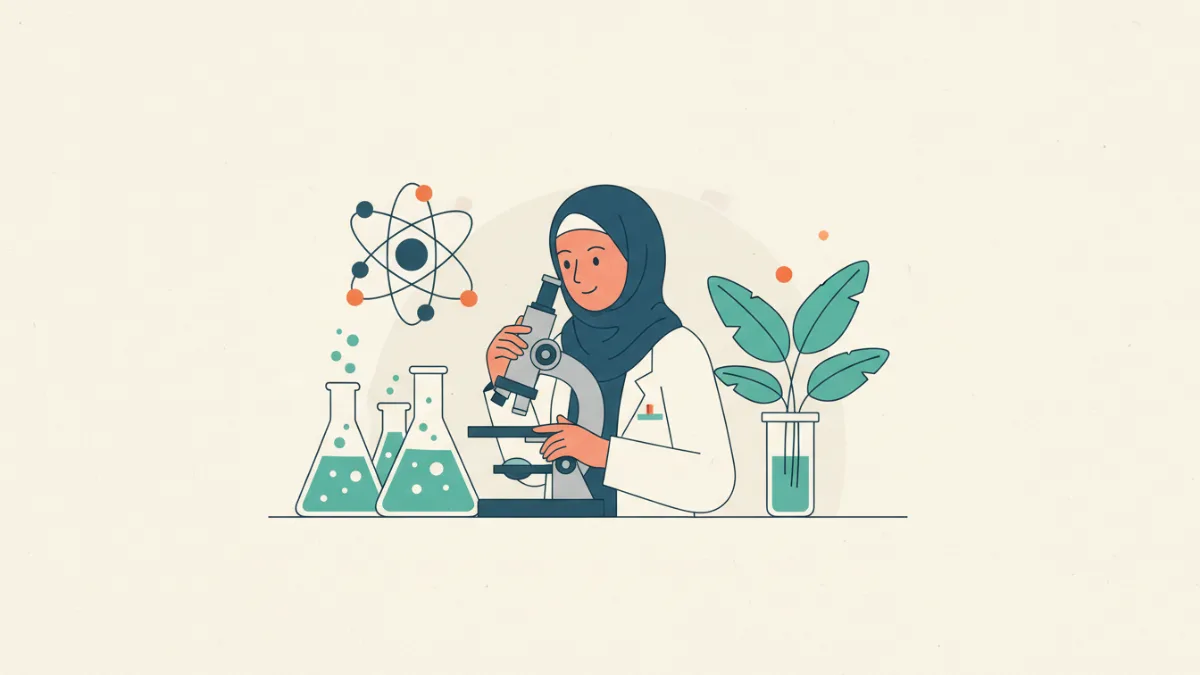
About this assessment
Medical, engineering and science majors assume you arrive with a solid science foundation. This assessment checks your understanding of core high-school concepts rather than memorized definitions.
It has 15 questions in four areas: physics, chemistry, biology and the scientific method. In the last area you read a description of a simple experiment and its results and decide what the results actually support. Some questions need a short calculation, so have paper and a pen ready.
When you finish you see your score in each area and the correct answer and explanation for every question.
What it measures
- Physics: force, motion and electricity
- Chemistry: chemical change, molar mass and equations
- Biology: the cell, genetics and the human body
- Scientific method: hypotheses, variables and reading results
What your results tell you
- Your overall score and level out of four
- Your score in physics, chemistry, biology and the scientific method
- The correct answer and explanation for every question
- Steps and courses to strengthen your weakest area
Why it helps
- See whether you are ready for a science, medical or engineering major
- Find the subject to review before an admission or scholarship test
- Practice reading experiments and avoiding overstated conclusions
- Get an explanation for every question and suggested courses
Areas covered
Physics
Understanding force, motion and electricity and using their basic laws.
Chemistry
Telling types of change apart, calculating molar mass and using balanced equations.
Biology
Understanding the cell, genetics and the systems of the human body.
Scientific method and experiments
Understanding hypotheses, variables and repetition, and drawing only what results actually support.
Result levels
- 1Needs groundwork
There are clear gaps in the science basics. If you plan a science or medical major, start a structured review of one subject at a time, focusing on understanding rather than memorizing.
- 2Developing
You understand part of the core concepts, but one or more subjects need work. Review the explanations for the questions you missed and start with your lowest-scoring area.
- 3Proficient
Your science foundation is good enough to start most science majors. Pay attention to calculations and units, and keep practicing reading experiments and their results.
- 4Advanced
You master science at this level and think like a scientist. Look for summer research programs, science competitions and scholarships that favor strong science students.
Before you start
High-school science. Have paper and a pen for simple calculations.
Sample question
One of the questions in this test. The right answer and an explanation are in your report after you finish.
- Newton
- Watt
- Pascal
- Joule
Frequently asked questions
- Is the Science Proficiency assessment free?
- Yes. It is free, and so is the full report. You only need a free For9a account so your answers and result are saved.
- How long does it take?
- About 20 minutes, with 15 questions.
- How is it scored?
- Each question has one correct answer (or a set of correct answers). Your score is the share of questions you answer correctly, and it is also broken down by skill area so you can see where you are strong and what to practise.
- What does my result mean?
- It shows how well you know the material today, your level, and the areas to work on, with courses and opportunities that match. Use it to plan your learning, not as a final judgement.
- Is the result an official certificate or diagnosis?
- No. For9a assessments are guidance and self-development tools. They are not an official certificate, a psychological or medical diagnosis, or a replacement for an exam required by a university or employer.
- Can I take it again?
- Yes, 24 hours after your last attempt, so you have time to review your answers and practise.
- Can I stop and continue later?
- Yes. Your answers are saved as you go, so you can close the page and continue from where you stopped.
These assessments are guidance and self-development tools, not a psychological diagnosis or an official certificate.
Last updated 29 November 2026How we build and score these assessmentsEditorial policy
Related assessments
Critical Thinking
A timed test of spotting hidden assumptions, evaluating arguments, interpreting evidence and recognizing logical fallacies in work and study situations.
- 20 min
- 15 questions
- Intermediate
- Timed

Are You Ready to Study Abroad?
Check your readiness to study abroad across language, documents, applications, funding and personal preparation, and see what is missing.
- 8 min
- 20 questions
- Beginner